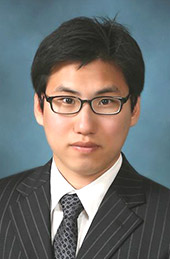
[Edaily Reporter Kim Seung-kwon ] “I was deeply impressed when I first encountered ‘ChatGPT’ in late 2022. Immediately afterward, we attempted a major pivot, shifting the company’s entire development strategy toward generative AI. ‘MedZero,’ a healthcare-specific foundation model set to be unveiled by the end of the year, is already outperforming Google’s medical AI, ‘MedGemma,’ in key benchmark tests.”
Choi Woo-sik, CEO of DEEPNOID Inc.(315640), explained the competitive landscape with Google in an interview with E-Daily on the 13th following an event regarding government approval of the company’s generative AI model. This effectively signals a head-to-head competition, given that Google has invested massive capital to launch a foundation model dedicated to healthcare. He expressed confidence that his company’s results would be proven through concrete performance starting at the end of this year.
Choi Woo-sik, CEO of DEEPNOID Inc. (Photo: ReporterKim Seung-kwon )
◇ DEEPNOID Inc.’s New Weapon Is a Foundation Model… But Has Google Already Taken the Lead?
DEEPNOID Inc. is ambitiously preparing to drive a rebound in the second half of the year with its new weapon: “MED ZERO,” a multimodal foundation model specialized for healthcare. This model has been intensively trained on approximately 4 trillion text tokens and a vast amount of medical imaging and literature data totaling 1 petabyte (PB). Development began early this year, and the project is now more than 50% complete, with an official launch scheduled for the end of the year.
A notable feature is the scale of its parameters. MED ZERO is being developed with 32 billion (32B) parameters. CEO Choi explained, “Since the medical field handles patients’ sensitive personal information, a closed, on-premise environment utilizing internal hospital servers is essential rather than a public cloud,” adding, “The 32B scale is the most optimized size for stable and rapid operation when deployed within a hospital.”
MedZero’s performance has already reached a level that poses a threat to global big tech companies. CEO Choi emphasized, “When compared to MedGemma, Google’s flagship medical model, MedZero is demonstrating overwhelmingly superior performance across four key evaluation areas, including medical image understanding and report generation.”
The ultimate vision CEO Choi envisions for MedZero is a “medical Agent AI.” Currently, most hospitals operate with a fragmented software ecosystem—including Picture Archiving and Communication Systems (PACS), Electronic Medical Records (EMR), and Order Communication Systems (OCS)—with each solution provided by a different vendor. Integrating these into a single system or completely replacing them is practically impossible given the massive data structures of large hospitals.
CEO Choi explained, “Instead of overhauling existing software, we’ve adopted an approach of layering a MedZero-based ‘agent’ on top of it,” adding, “By leveraging cutting-edge technologies such as the Model Context Protocol (MCP), we can organically interconnect software from different vendors to dramatically improve hospitals’ clinical and administrative workflows.” The goal is to go beyond a simple chatbot and serve as a proactive assistant that addresses actual inefficiencies in hospital administration.
The barrier to commercialization has also been significantly lowered. “M4CXR,” the company’s existing AI-powered chest X-ray interpretation assistance solution, took a long one and a half years just to receive product approval from the Ministry of Food and Drug Safety. In contrast, MedZero focuses not only on diagnostic assistance but also on streamlining hospital administration and workflows, making it possible to implement the solution immediately in hospital settings without going through cumbersome approval procedures. Since it is not subject to National Health Insurance reimbursement rates, the company is expected to rapidly expand its commercialization efforts starting next year.
A breakthrough has also been achieved regarding the issue of exorbitant “operating costs,” which has long been cited as a chronic limitation of generative AI. DEEPNOID Inc. has partnered with AI semiconductor startup FuriosaAI to adopt “Renegade,” a next-generation neural processing unit (NPU) specialized for inference. By utilizing a dedicated NPU instead of expensive, hard-to-find foreign-made GPUs, the company has significantly reduced service operating costs. This effectively establishes a robust infrastructure that allows not only large hospitals but also small and medium-sized neighborhood clinics to adopt medical AI without financial burden.
CEO Choi stated, “No matter how innovative or impressive AI technology may be, if it’s limited to simply asking and answering questions, the entities responsible for paying—hospitals—won’t open their wallets.” He added, “Our current solution has achieved overwhelming productivity, completing image interpretation in just 1–2 seconds. Ultimately, the future of the global healthcare market will hinge on ‘Agent AI’ that delivers tangible efficiency.”
DEEPNOID Inc. Medical AI Foundation Model (Photo: DEEPNOID Inc.)
◇ Prioritizing the Japanese and Southeast Asian Markets... Expectations to Secure a Blue Ocean
DEEPNOID Inc. plans to rapidly accelerate its “revenue clock,” which had been dormant, starting with the launch of MedZero at the end of the year. The company anticipates that meaningful orders and revenue from solutions such as chest X-ray systems will begin to materialize as early as the fourth quarter of this year, once the rigorous performance validation periods at major hospitals are completed.
The company is also taking a strategic approach to expanding into global markets. Rather than fixating on U.S. Food and Drug Administration (FDA) approval—which many K-medical AI companies are blindly pursuing—it has adopted a practical “localization-targeting” strategy that can generate immediate cash flow.
CEO Choi has identified Japan and Southeast Asia as the company’s primary global targets. “Typically, entering the U.S. market takes an excessively long time, from regulatory approval to actual adoption in clinical settings,” he explained. “Since DEEPNOID Inc.’s solutions offer practical utility that can immediately and effectively assist with diagnoses in clinical settings, we will prioritize Japan and Southeast Asia—where regulatory barriers are relatively low and demand for healthcare infrastructure automation is skyrocketing—to secure a blue ocean market.”
Another key point to watch is the quiet yet steady progress in the “industrial AI” sector, which provides solid support for the company’s core medical AI business. DEEPNOID Inc. currently firmly holds the top spot with an overwhelming market share in South Korea’s airport security X-ray AI market. Its solutions are already deeply integrated into the smart factories and security screening lines of major domestic institutions and companies.
Global expansion has also already begun. The company recently formed a strong partnership with “Smith Detection,” a global equipment manufacturer based in Switzerland. CEO Choi explained, “We are expanding our core technology beyond simple offline equipment screening into the realm of cloud-based remote security screening,” adding, “In particular, starting this year, we will begin to generate steady revenue from ‘paid maintenance’ contracts in the industrial security AI sector, moving beyond one-time implementation fees.” Given the unique nature of industrial AI, where revenue is typically concentrated in the second half of the year, the company is expected to lay a solid foundation for a return to profitability starting this year.
Concluding the interview, CEO Choi said, “We are acutely aware of the market’s harsh criticism that, despite their outstanding technological capabilities, Korean medical AI companies have failed to fully prove their worth in terms of numbers.” He added, “Now that DEEPNOID Inc. has steadfastly weathered this period of technological upheaval, we will become a company that answers the market’s questions with tangible revenue metrics and clear results starting in the second half of this year.”
This week (October 19–23), startups in various sectors—including accommodation solutions, AI video production, and digital healthcare—secured investments from venture capital (VC) firms and accelerato…
We’re in an era of recession-driven consumption, where we want a lot but our wallets are light. Our reporter personally tests and evaluates “value-for-money alternatives” that let you keep up with tre…
Korean small-cap pharma, biotech, and healthcare stocks moved in opposite directions on Oct. 22, as large-cap chipmakers weakened. Rokit Healthcare posted the steepest decline on the KOSDAQ, while in-…